- Listen to it on Apple Podcasts.
- Listen to it on Spotify.
- Listen to it on YouTube Music or YouTube
- Listen to it on Audible and Amazon Music
One of the most common questions I get, and honestly one of the biggest sources of anxiety for anyone nearing financial independence is: “How much can I spend without running out of money once I quit my job and start living off my investments?”
It’s one thing to see a big number in your investment account; it’s another thing entirely to hit the “withdraw” button and start taking money out.
Research, and my own experience shows that many Canadians end up underspending. They live a smaller life than they need to simply because they don’t have a structured process they can trust.
Some blindly follow the “4% rule,” while others just live off dividends, pensions, and/or government benefits, never touching their principal. This often results in a massive amount of money left over when they pass away. That is money that could have been spent enjoying life, creating memories with family, or donating to charity, rather than leaving a giant inheritance, and a giant tax bill to the government.
So, how do we find that balance? How do we calculate a spending number that is safe, but still lets us enjoy our lives?
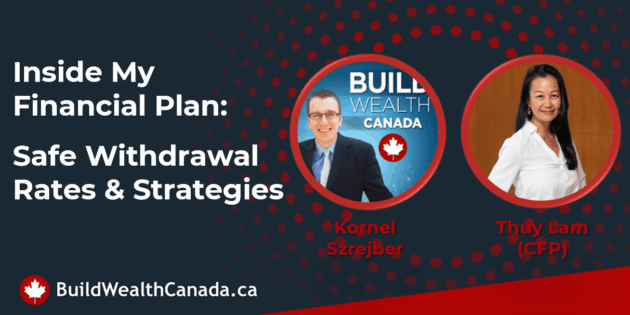
To answer this, I invited Thuy Lam back on the show. Thuy is a Certified Financial Planner with over 20 years in the industry who recently built my personal financial plan. We discuss the specific cashflow plan she created for us, and the relevant insights and best practices you can apply to your own situation.
We dig into four critical areas:
- First, the “Safe Withdrawal” question: We move past the 4% rule and discuss how to determine a sustainable spending rate that factors in current market conditions.
- Second, the “Bucketing Strategy.”: Thuy breaks down how to allocate your portfolio for short-term spending versus long-term growth. This is huge for keeping anxiety low when the market drops.
- “Stress Testing” your plan: We talk about why using a simple average rate of return (like 8%) is a dangerous mistake, and how Monte Carlo simulations can help you see if your plan survives extreme scenarios.
- Dynamic Spending Adjustments: We cover exactly when to tighten the belt if markets underperform, and how to safely increase spending if returns are high, so you don’t die with a giant portfolio you never got to enjoy.
We’re going to cover all that and more. Enjoy the Episode!
Links from the episode:
Meet with Thuy: Free Introductory Meeting & Discount Link
Free access to my investing guide: What I Invest In and Why? (Kornel’s Portfolio)
A Big Thanks to Our Sponsors:
BMO Asset Allocation ETFs: One of the Lowest Cost Options in Canada:
Do you keep hearing about these “All-in-one ETFs” lately? Well, I have some exciting news:
BMO ETFs just cut the fees on their flagship all-in-one ETFs to 0.15% making them one of the lowest cost options in Canada. That’s right – more value, same smart diversification, all in a single ETF.
Whether you’re just starting out, or simplifying your portfolio, BMOs all in one ETFs make it easy to invest with confidence.
Just Zed it and forget it by considering ETFs like ZEQT, BMO’s All Equity ETF or ZGRO, BMO’s Growth ETF.
“Views from the Desk” Podcast

On this podcast, we often cover best practices that can not only help you now, but will also be relevant throughout your investment lifetime. But what if you also want an update on what is happening with your investments, the markets, and the economy right now?
To help me stay up-to-date on these topics, a great Canadian podcast that I listen to weekly is called “Views from the Desk” (Apple, Spotify, Direct).
They provide timely information for us Canadians on what is happening to our investments right now, as well as other key factors affecting us like changes to our interest rates, our inflation, and regulatory changes that we should know about.
The podcast is hosted by BMO ETFs. I’m a huge fan of theirs, I own a lot of BMO ETFs myself, and it’s a great free resource for both new and existing ETF investors.
I hope you check them out. All episodes are available for free in your favourite podcast player. Just search for “Views from the Desk” or click one of the links below:
ETF Market Insights and BMO ETFs
Catch the latest episodes on YouTube Here.
There are so many opinions on how to invest your money today, but it can be hard to find credible voices to rely on in the world of finance and investing.
One resource I turn to every week is the ETF Market Insights YouTube channel, led by today’s episode sponsor, BMO ETFs.
Market Insights brings in industry experts and their weekly episodes cover the hottest themes like inflation, infrastructure, healthcare, and more. Tuning in helps me stay up-to-date on what’s happening so I can be a smarter investor. You can also submit your own ETF questions, to be answered on the show.
Do yourself a favour and subscribe on YouTube to ETF Market Insights, or visit ETFMarketInsights.com so you can be notified when future episodes go live.
BMO Asset Allocation ETFs:
Asset allocation explains over 90 per cent of the variation in a portfolio’s quarterly returns, so it’s no wonder Canadian investors are turning to these ETFs!
Today’s sponsor, BMO ETFs, offers these innovative all-in-one solutions with the BMO All-Equity ETF (ZEQT), BMO Growth ETF (ZGRO), BMO Balanced ETF (ZBAL), BMO Conservative ETF (ZCON), and more. BMO developed these to help provide investors with ETFs that offer broad diversification and are also low-cost and simple to use.
These ETFs invest in a number of underlying index based ETFs and are rebalanced automatically back to your set asset allocation or mix of stocks and bonds. They offer a hands free approach to investing that is built on disciplined weights to provide exposure to different geographies and sectors all in one solution.
BMO actually offers eight asset allocation ETFs. Learn more at BMOETFs.com.
Questions Covered:
- Thuy, when you did our financial plan, one of the main questions that I had for you was “How much can we sustainably withdraw from our investment portfolio so that we can live off it permanently and never have to go back to work”.
We all have this question at one point or another in our lives and from what I’ve seen in the research, with myself personally, and in talking with others is that many people actually tend to underspend once they start to live off their investment portfolio, and they do this just to be safe, because they don’t have a safe spending number that they are confident is correct.
What is the correct way that we should all be tackling this “safe withdrawal” question and what should be factored in when this analysis is being done? as opposed to just blindly following the 4% rule for life (for example), or just living off the dividend and interest income that our portfolio generates and never actually drawing down and fully utilizing our investments. - I personally like the bucketing approach, where we allocate a portion of our investment portfolio for short term spending needs, and a portion toward mid-term and long term spending needs. I find it helps keep my anxiety low. But, one of the other reasons that I reached out to you to help us with our financial plan, was I kept questioning myself on when I should refill the short term cash bucket for day-to-day expenses, or when should I stockpile some cash? (for example if the markets are doing well so it makes sense to refill the bucket, or if we’re going on vacation and need to stockpile some cash for that.)
I think I, along with many of those listening could really benefit from a good set of cash bucket rules to follow so that we don’t have to keep questioning ourselves each time something happens in the stock market and then we start deliberating on whether now is a good time to refill that safety bucket, and by how much.
Can you give us some sort of structured process for handling this, based on what you’ve seen to work well for you clients, along with any best practices that you’d suggest? - One of the things that I really appreciated when we worked with you was how after you made sure our information was entered correctly into the financial planning software and after you did your analysis for us I was able to actually go into the financial planning software myself and run different what-if scenarios. For example, what if we spent an extra $20,000 a year or what if we earned some extra side income versus not, while retired.
When working with a financial planning software and a financial planner or just doing it ourselves, there is always that initial baseline (the current scenario, the status quo), but what are some of the other scenarios that we should consider running, whether we’re doing it ourselves or working with a financial planner? - One of the common mistakes that I see some DIY investors and even financial advisors make, is just using an average rate of return for their portfolio over their entire lifetime.
For example I’ve seen 8% commonly used as the average long-term return for stocks and so when they try to model things out they put in that the portfolio will definitely earn 8% on their stocks, every year, until the day they die.
The problem with this being that it doesn’t take into account the variability of the market. For example the stocks could be up 20% one year and down 30% another year, and of course this can give you drastically different projections compared to just assuming a static 8% return every single year.
One of the ways to help fix this problem, is to use Monte Carlo simulation to run different variations of historical market returns so that we can actually see the range of outcomes of what our portfolio could be at under different market conditions over time, and the probability of our financial plan actually succeeding. Can you speak to this a bit more for anybody that is new to this and is hearing about it for the first time? - When you did our plan, and when I ran my own scenarios in the software, the program ran the monte carlo simulation on each scenario so that I could see the probability of success and possible range of outcomes based on our annual spending and investments.
I noticed that it also showed us outcomes for our situation assuming the markets performed to their historical average vs performed below average vs outperformed the historical average (i.e. It gave us a best case, worst case and average scenario).
Let’s say we do our financial plan, we see this range of outcomes for our plan and are happy with it. Now fast forward 5 years and it looks like we got unlucky and received below average market returns over that time. At what point should we start making adjustments in our spending and by how much so that our portfolio can continue to sustain us and not force us to go back to work in the future? What is the process to follow and how often should we do this analysis? - On the flip side, let’s say that we instead got above the historical average market returns over that time while our spending has stayed the same (adjusted for inflation) according to our initial plan. What is the process that we would now follow to increase our spending so that we don’t end up with a giant portfolio upon death that we could have enjoyed while we were alive and healthy?
- Thuy, you have been doing this for over 20 years now. Over that time, after working with many different types of clients, can you give us some of the top mistakes that you’ve seen Canadians make when it comes to their finances. In particular, I’m looking for the truly significant things that can really impact someone else’s life whether it’s avoiding a major mistake, or getting something on a person’s radar that can substantially positively impact their life.
- Thuy, thank you so much for coming on and for doing our financial plan for us. I’m definitely a lot less anxious after having gone through the process with you and I really appreciate your high level of understanding when it comes to financial planning, and the level of detail that you went through with us to make sure that everything is modelled out correctly in the software so that you could properly analyse everything, and so that even months after we first met, I can still run different scenarios using the software myself.
For anybody listening that would potentially like to chat with you to see if you’re a good fit for each and maybe work together, can you take us through the process, but before you do that, for anybody interested, that discount link for the 10% off at Objective Financial Partners (where Thuy works), is over at buildwealthcanada.ca/plan.
Disclaimer:
This podcast and video is for information purposes. The information contained herein is not, and should not be construed as, investment, tax or legal advice to any party. Particular investments and/or trading strategies should be evaluated relative to the individual’s investment objectives and professional advice should be obtained with respect to any circumstance. Commissions, management fees and expenses all may be associated with investments in exchange traded funds. Please read the ETF Facts or simplified prospectus of the BMO ETFs before investing. Exchange traded funds are not guaranteed, their values change frequently and past performance may not be repeated. For a summary of the risks of an investment in the BMO ETFs, please see the specific risks set out in the BMO ETF’s simplified prospectus. BMO ETFs trade like stocks, fluctuate in market value and may trade at a discount to their net asset value, which may increase the risk of loss. Distributions are not guaranteed and are subject to change and/or elimination. BMO ETFs are managed by BMO Asset Management Inc., which is an investment fund manager and a portfolio manager, and a separate legal entity from Bank of Montreal. BMO Global Asset Management is a brand name under which BMO Asset Management Inc. and BMO Investments Inc. operate. “BMO” is a registered trademark of Bank of Montreal, used under licence..



Leave A Response